Future-proof IT solution for an early warning system in the supply of essential medicines.
Background
In 2023, Switzerland increasingly faced challenges in securing supplies of essential human medicines. Difficulties in global supply chains and changes in the market have exacerbated national and international supply shortages. In the 2022 report on the supply situation, the Federal Office of Public Health (FOPH), Swissmedic, the Armed Forces Pharmacy and the Federal Office for National Economic Supply (FONES) analysed the situation and formulated measures to improve the way in which shortages are monitored.
The previous reporting platform, which had been in operation since 2015, could no longer cope efficiently with the increasing requirements and had reached end of life.
Mandate and implementation
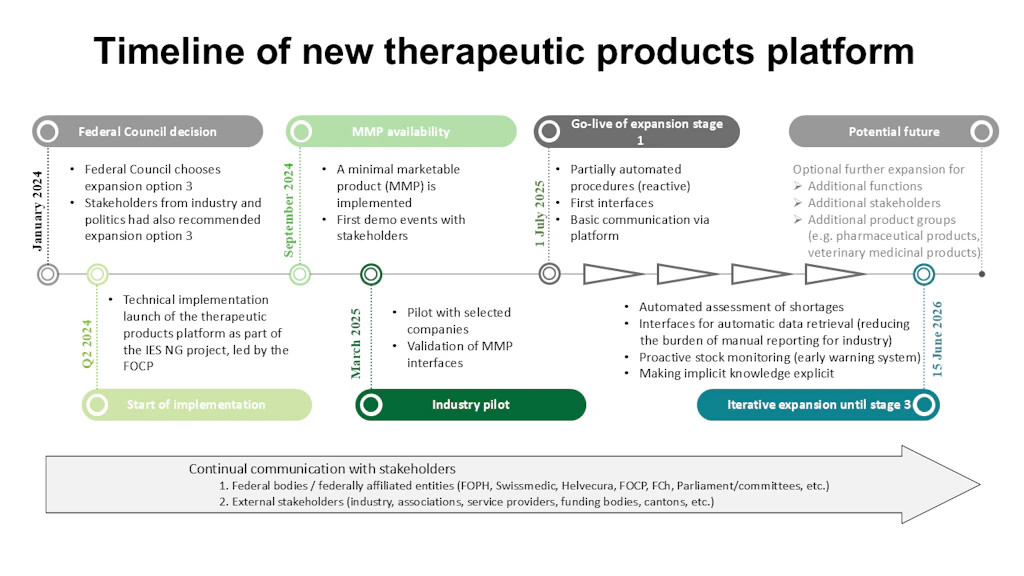
In January 2024, the Federal Council decided to implement the proposal for a new Platform of therapeutic products which emerged from a study conducted by the FONES. As a semi-automated and scalable long-term solution, the new platform will improve the efficiency and transparency of what are currently mostly manual processes in the therapeutic products sector. It will be modular and expandable in such a way that further therapeutic product groups can be integrated as required.
The project "Platform of therapeutic products" pursues the following objectives:
Replace the current reporting platform with a modern monitoring platform that utilises synergies and links all stakeholders through standardised data connections;
Increase the efficiency of the reporting office and the authorities by providing a broader database in order to ensure the quality of decisions despite increasing complexity;
Replace reactive reporting behaviour by proactive monitoring in order to stabilise supply for healthcare organisations and patients.
Project schedule
The overall schedule for IES NG and further information on the project can be found on the Federal Office for Civil Protection (FOCP) website (de, fr, it).
The key TPP project milestones are:
June–October 2023: Study drawn up with the involvement of industry associations and subsequent office consultation
January 2024: Federal Council decision and project launch
1 July 2025: TPP go-live in expansion stage 1
15 June 2026: Go-live of TPP expansion stage 3 for proactive monitoring
You can find training materials for the platform here.
Details of the individual expansion stages and new functionalities are communicated directly to the relevant stakeholders on a regular basis.
FAQ
In January 2024, the Federal Council decided to upgrade the previous reporting platform into a high-performance, forward-looking monitoring system. The Therapeutic Products Division within the Federal Office for National Economic Supply is carrying out this task in two expansion stages:
On 1 July 2025, the new therapeutic products platform (TPP) went live. This basic version still uses the previous, reactive reporting processes. However, it offers a significant increase in efficiency and a modern interface thanks to full digitalisation of the relevant administrative processes and standardised interaction with marketing authorisation holders.
The following procedures are handled via the TPP:
Reporting supply shortages or delivery disruptions of a pharmaceutical product subject to the reporting obligation
Reporting market withdrawals
Applying to release compulsory stocks of pharmaceutical products
Responding to market surveys on pharmaceutical products subject to the reporting obligation
On 15 June 2026, the TPP will be upgraded into a proactive monitoring platform. This will enable the Reporting Office to identify market trends and potential shortages at an early stage. Any measures that need to be taken as a result will aim to minimise or, if possible, prevent shortages of essential human pharmaceuticals. From a technical perspective, the proactive monitoring will be automated to the maximum extent possible, and there will be an option to use an interface.
The following processes will also be handled via the TPP:
Applying for exemption from compulsory stockpiling
Applying for a reduction in compulsory stock quantities
Regardless of the reporting frequency required for a specific product or product group, the following channels are always available and can be used interchangeably:
1. Manual file upload
Data is entered manually into the TPP. For data that needs to be submitted on a daily basis, FONES provides a CSV template that can be completed in advance and then uploaded in the TPP user interface (file upload). This option is also the fallback solution if an interface is unavailable.
2. Direct interface
The TPP offers the option to retrieve the data directly from the marketing authorisation holder using an automated process (e.g. in an ERP system).
3. Via a service provider FONES enables Swiss third-party providers (e.g. pre-wholesalers) to submit stock and sales data directly to the TPP on their clients’ behalf. You can find out whether pre-wholesalers offer this option and in what form by contacting them directly.
Please note: For the time being, marketing authorisation holders must still enter scheduled deliveries into the TPP manually via file upload on a weekly basis, as pre-wholesalers are at present unaware of these deliveries.
The reporting party is free to choose which channel to use for data submission and may change this if required. Regardless of the reporting channel they choose, all marketing authorisation holders are treated equally. Data ownership and responsibility for the accuracy of the reports always remain with the marketing authorisation holder.
For all human pharmaceuticals subject to the reporting obligation or compulsory stockpiling, the following information has to be submitted:
- Daily sales figures for the last 12–24 months - Current stocks - The date and quantity of the next scheduled and confirmed deliveries - Known supply shortages or delivery disruptions lasting at least two weeks
In future, the new therapeutic products platform will store sales and stock data for each calendar day. This data, as well as details of the next delivery dates and quantities, must be entered on a regular basis. This may be daily or weekly, depending on the submission channel. The frequency can be adjusted if necessary (e.g. in a crisis situation such as a pandemic).
The specific data the marketing authorisation holder shares when using a third-party provider’s interface is subject to the agreement between the authorisation holder and provider. This agreement can be revoked or amended at any time. The third party submits the data to the NES Reporting Office via an application program interface (API). The Reporting Office uses this interface to automate the data and retrieve it automatically at regular intervals for the purposes of proactive monitoring in the TPP.
The NES Reporting Office offers its statutory service to businesses free of charge. When designing the new therapeutic products platform (TPP) for proactive monitoring, the focus was on making data submission as automatic as possible for marketing authorisation holders, thereby minimising their administrative burden. It should be noted that, if data is submitted via a third-party service provider (e.g. a pre-wholesaler), fees may be incurred by the service provider. These are to be paid by the reporting party.
The ‘once-only’ principle is integrated into the vision for the new therapeutic products platform (TPP). It must be implemented wherever possible, in compliance with the legal framework set out in Article 8ff. of the Ordinance on the Essential Human Pharmaceuticals Reporting Office. The transfer of data between federal offices and other bodies is strictly regulated by law.
Based on the ‘once-only’ principle, the new TPP obtains data from the following institutions:
Swissmedic (via refdata): - Pharmaceutical product master data
Helvecura: - Data on actual and target stock levels for compulsory stocks of pharmaceutical products
The transfer of data is regulated in Article 8ff. of the Ordinance on the Essential Human Pharmaceuticals Reporting Office.
This provision is provided below for reference: Art. 8 Data disclosure principles
1 Data from the therapeutic products platform may only be disclosed to:
a. the health authority of a canton or the Confederation: in order to fulfil its statutory mandate;
b. third parties, provided they use the data exclusively for scientific purposes.
2 The Reporting Office must anonymise the data prior to disclosure under paragraph 1 letter b, and ensure that no inferences can be made regarding business or manufacturing secrets.
3 Data recipients must use organisational and technical measures to ensure that the data is used exclusively for the stated purpose. The data may only be disclosed with the Reporting Office’s consent.
Article 9 governs data disclosure to the Swiss Agency for Therapeutic Products, and Article 10 governs data disclosure to Helvecura.